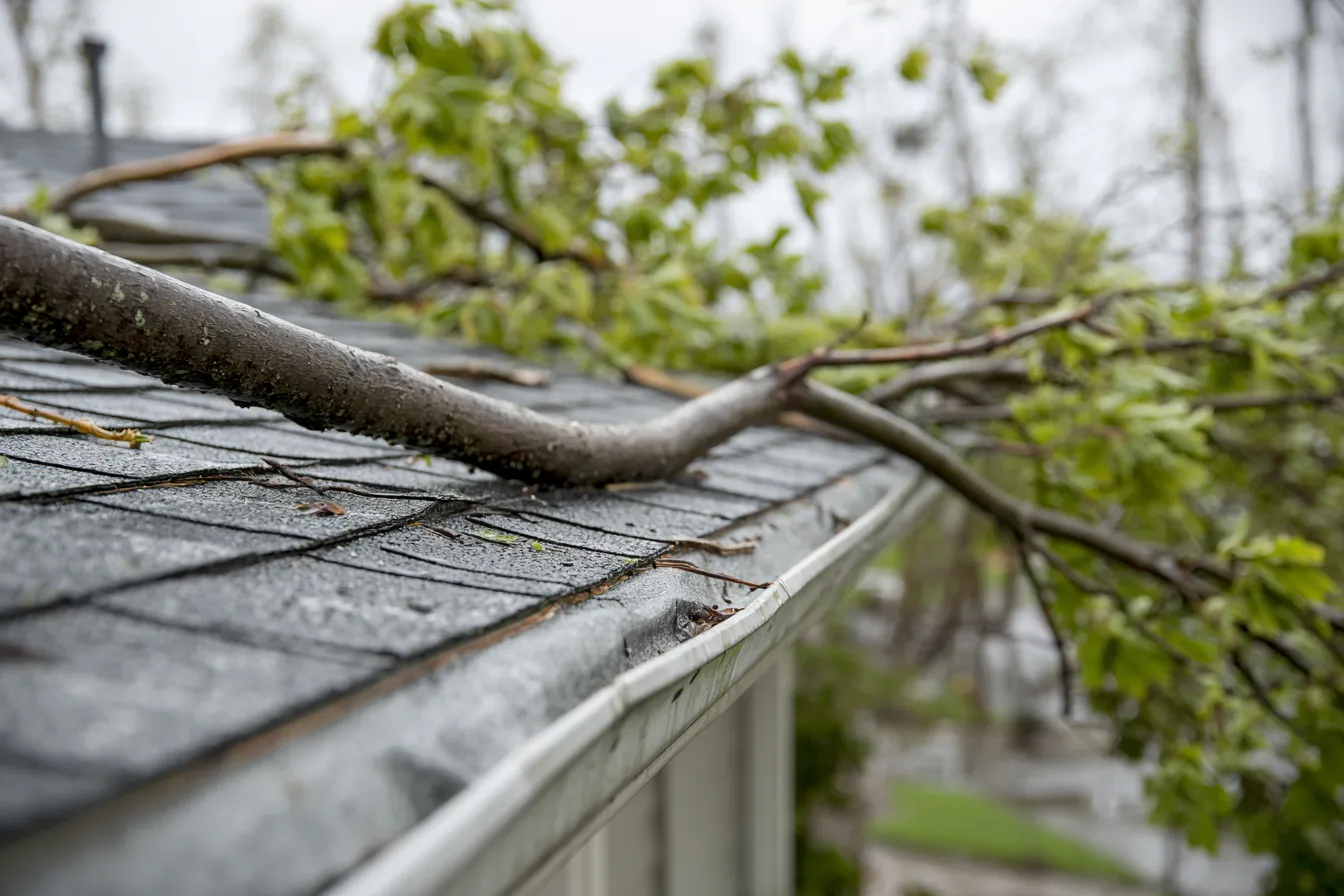
Hail is the thing that ages roofs fastest around here, and it does not arrive evenly. Four hail springs in a row have left Siloam Springs roofs at every stage, from untouched to finished, and the dates decide which one is over your head. This guide sets out the storms that mattered for this town and what each size of stone tends to leave behind on a shingle, so you know whether the roof you own is worth a look this year.
The four-year record, in plain numbers
Between 2023 and 2026 the NOAA and NCEI Storm Events Database logged 18 days of hail in Benton County, Arkansas, producing 100 separate reports. Fifty-two of those were an inch in diameter or bigger, which is the rough point at which asphalt shingles start taking damage rather than just noise. The largest single stone on the record measured four inches, reported twice, on March 14, 2024 near Sulphur Springs and again on April 28, 2026 near Cave Springs. The strongest wind in the same window hit 96 miles per hour.
Those are county numbers, and a county is a wide thing. The more useful entries are the ones that landed on Siloam Springs itself.
May 18, 2025, over Siloam Springs
On that one afternoon the reports around Siloam Springs included hail at one inch, one and a quarter inches, and one and three quarter inches, along with straight-line winds of 75 miles per hour. Golf-ball hail and 75 mile per hour wind in the same hour is the combination that does the most work on a roof, because the wind lifts the shingle edge and the hail lands on what it exposes.
A storm like that does not usually put a hole in anything. It bruises. The granules that give a shingle its weather layer get knocked loose, the mat underneath takes an impact it does not recover from, and the roof keeps looking ordinary from the driveway for a year or two while it quietly ages faster than it should.
What you can check yourself
The gutters are the honest place to start. A heavy load of granules collecting at the downspout after a storm is the roof shedding its surface, and it is visible without a ladder. Metal is the next tell: vents, valleys and any flashing that shows dents means the same stones hit the shingles beside them. Inside, a stain that spreads slowly across a ceiling after a storm season is usually a flashing joint rather than a hole.
None of that tells you the scale of the damage, and it is not meant to. It tells you whether it is worth having somebody go up and look, which is what a roof inspection is for.
Why the date matters more than the damage
Insurance policies in Arkansas are written against a specific storm on a specific date, so a claim is far easier to make when the damage can be tied to an event on the public record. That is the practical value of the list above: March 14, 2024, May 26, 2024, April 15, 2023 and May 18, 2025 are all documented, and a write-up that names the date it is describing is a write-up an adjuster can work with. How the claim side works is set out on its own page.
The reverse is also true. Damage found years later, with no date attached, is the hardest kind to get covered, which is the argument for looking after a storm season rather than after a leak.
Getting it documented
Send what you noticed to Siloam Springs Premier Roofing, and an independent local roofer covering this part of Benton County goes up and looks. What they find gets photographed and written down against the date of the storm it belongs to. The look costs nothing and nothing is signed for it. The roofing services page sets out what the work turns into once the findings are in.